Showing posts with label Starting Library. Show all posts

Saturday, January 19, 2008

Bonsai Techniques Vol I


Bonsai Techniques Vol I
by John Yoshio Naka
ISBN 0930422317 pp269

The “Nakas” are referred amongst Bonsaiist as the “Bonsai Bibles”
A lifelong work is described in these volumes. Because “these” are John’s notes, translated from Japanese, the description at times is a little thin. However, the learned hobbyist can easily extrapolate the necessary information as required. The “Nakas” are not “Bonsai Primers” and as such, are intended for intermediate to advanced Bosaiists. Before one delves into these magnificent books, one needs to understand the basics of bonsai and bonsai care.

Vol I will take a novice along quite readily, but it is this author’s opinion that, one needs to posses a firm grasp of bonsai basics, if one is to fully comprehend what John is trying to impart to his audience. It contains a great in-depth section on various soil uses, along with recommended soil recipes for various trees. An in-depth monthly care guide can also be found in this book. If one is looking for traditional Japanese values, one will find them here.

Bonsai techniques Vol II


Bonsai techniques Vol II
by John Yoshio Naka
ISBN 093042233 pp 442

Bonsai techniques Vol II is more or less on advanced “bonsai techniques” and as such is not for beginners, I purchased mine at the same time as Vol I. Although, my apprenticeship is far from being at the level to apply advance techniques listed in this book, I found it extremely inspiring and educational. One thing it has taught me since I have read the book, was to seek inspiration from nature, find an appropriate tree (raw material) and duplicate the inspiration. John had a saying; don’t make your tree look like a bonsai, make your bonsai look like a tree. Walter Pall is famous to some extent for this exact approach. Considered a “rebel” in the beginning, Walter’s battle gained credence for his work. His innovative approach to the art has forged a way for the future. This is also the direction I intend taking in the future. I will no doubt meet allot of controversy during my journey, but at least learned veterans of the likes of Walter and many others have paved my chosen path. To the true “traditionalist” well! Walter’s work is totally unacceptable.

This book goes into great details with regards to grafting whether grafting roots or branches. Detailed descriptions on each are available; it goes on further to explain which method gives a greater chance of success depending on the tree species. The book then naturally flows to the trunk, branches and apex. This is where John goes into great detail with regards to the fundamentals of branch placement, height ratios etc. No serious Bonsai Artist would be without them.

Home Gardener’s Problem Solver


Home Gardener’s Problem Solver
by Ortho Books
ISBN 0897215044
Published 2004
Meredith Publishing Group

This book “soft cover” book contains all known diseases and afflictions your plants, flowers, vegetables and trees may be infected with. As previously stated, because it is a book published by “Ortho” the recommended remedies are with the use of “Ortho’s products.” However, they do give the treatment and providing you follow their recommendation as to which chemicals to use for remedy, you should be able to treat your tree to full recovery. The latter is really a problem here in Canada as many pesticides are now banned. In Nova Scotia, outside of organic treatment of pests and diseases or harmless chemicals, there is little alternative. However, the book diagnoses the problem you might have in great detail, including pictures of the possible affliction.

The book is broken down into the following main categories:

a. Houseplants;
b. Lawns;
c. Ground covers;
d. Annuals perennials and bulbs;
e. Trees, shrubs and vines;
f. Vegetables, berries and grapes;
g. Soil, cultural, and climate problems;
h. Gallery of plant diseases;
i. Gallery of insects; and
j. Gallery of weeds, to name a few.

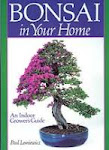
Bonsai in your Home


Bonsai in your Home
by Paul Lesniewicz
ISBN 0806907819 SC pp.207
Published 1996
Sterling Publishing Co, Inc.

The most comprehensive “soft cover” book for indoor bonsai care, highly recommended. If you want to grow indoor bonsai, this book is a must-have, in my opinion. It contains a good overall list of the lighting requirement for the vast majority of inside trees. The care requirement of individual trees is well addressed. Although, the book contains but a few short sections with regards to pruning, styling etc… In my opinion the latter does not diminish the value of this book as, one purchases this book solely for plant selection and care.

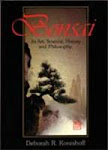
Bonsai It’s Art, Science, History and Philosophy


Bonsai It’s Art, Science,
History and Philosophy

by Deborah Koreshoff
ISBN 0908175752 HC pp.255
Published 1984
Boolarong Publications

The crown jewel of my collection
Some might disagree with me on this one, but I believe it is, without a doubt, the best-written book on the subject. This book was out of print for quite some time and hence, difficult to find, as a matter of fact because the market demand was so great for a while, used dealers took it upon themselves to make a quick buck, selling used copies at exorbitant prices, the majority of which were paperbacks. After months of surfing the net, I was fortunate enough to acquire a used hardcover copy, in excellent condition for a very good price. The publisher as ordered another print of this magnificent book and it is once again widely available to the public. If history was any indication I would not hesitate in acquiring one before the well runs dry once again.

A short biography
Deborah was born in 1957 into a world of bonsai. Her father, born in Harbin, Manchuria, was also surrounded by bonsai and absorbed the knowledge from the old Chinese gardener who tended them. From infancy, Deborah was exposed to club meetings and lectures/presentations by her parents, and had her own collection from a very early age. By the time she was 14 she was showing remarkable talent, and her first demonstration was given to the Bonsai Society of Australia.

In 1976, her parents’ Bonsai Nursery became the only authorized branch of the Nippon Bonsai-Saikei Art Institute with the authority to issue the Japanese Certificates. In 1978, Deborah became the teacher and since has travelled extensively around Australia. She has been the Education and Program Officer for the Bonsai Society of Australia and is the artist and major contributor for the magazine “Bonsai Australia”

The book starts off with an in depth introduction to the Art of Bonsai and it’s history. I believe describing the origins an important aspect of what we do; it is further my belief that we need to know where we have been in order to know how to proceed. Although the book has the usual pre-requisites, Deborah takes them a step further with, a brief history on the subject at hand, which, offers the reader some perspective and first hand knowledge on how things developed over the centuries. This type of approach in my opinion offers the reader the rationale on why we do things the way we do, far too often this approach is not used, or is to shallow, leaving the reader with more questions than answers.

Deborah’s attention to detail is second to none. The book contains hundreds of illustrations and photographs. They say a picture is worth a thousand words and no truer statement can be said about this book. The graphics are clear and further emphasized with extremely good explanations, which even a novice in the art can make out. Although, I would classify this book as intermediate, it is indeed well suited for any audience from beginner to advanced.

Although, the Nakas are known in the Bonsai World as the “bibles” I have chosen to crown Deborah’s book the same. John Yoshio Naka was one off, if not the founder of Bonsai in North America. His books are his lifelong notes on the subject and are translated from Japanese. The information contained in his books is invaluable. However, because these books were translated from his personal notes, it leaves the reader with many unanswered questions, as I found the detail insufficient at times. Bonsai Techniques Vol II seems to have remedied the situation somewhat but in no way compares to the depth of detail in Deborah’s book. I am not promoting one over the other here, as these books stand on their own merits. I am willing to say, however, that should I have purchased the “Nakas” after Deborah’s book I would have been disappointed somewhat. Notwithstanding, one has to remember the source of the “Nakas”; these were his personal notes. The perceived missing information or detail was in his head and, those whom had the pleasure of meeting John would back up my statement that he was a walking “Bonsai Library”.